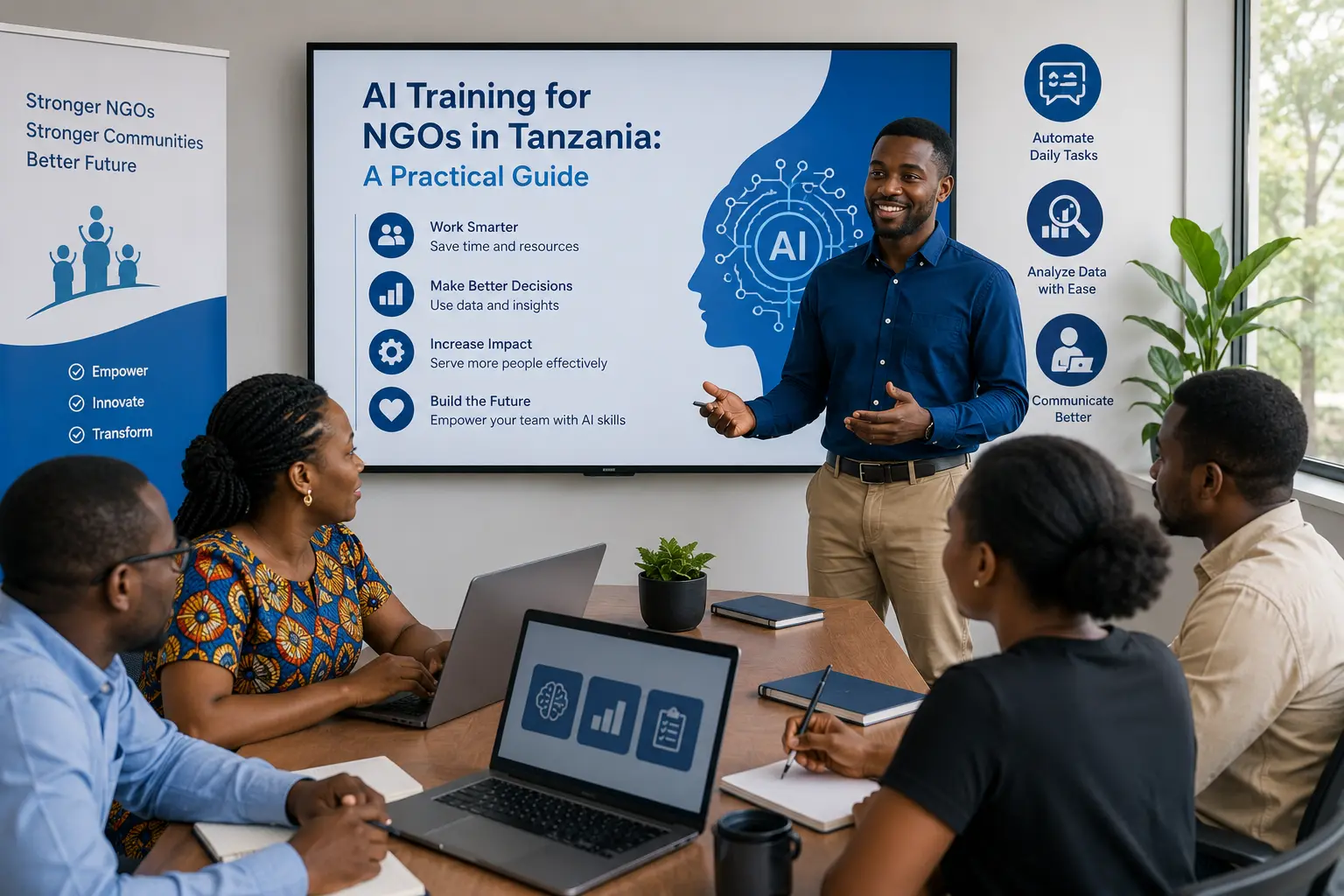
 AI Training
 for NGOs in Tanzania: A Practical Guide
Grayson Julius
Last Updated :
20th August 2026

By Grayson Julius
AI Strategist
Share this article with your friends
Quick Answer: AI training is becoming essential for Tanzania's workforce because AI has crossed from a specialist tool into a general workplace skill, the way email and computer literacy once did. Work is being reshaped task by task, rewarding people who can direct and check AI. In a country where around 800,000 young people enter the labour market each year and the region is the least AI-prepared in the world, training is the single factor that decides whether the workforce leads this shift or falls behind it.
Two people can do the same job in Tanzania today and get very different results. One spends the whole afternoon on a report that the other finishes before lunch, checks carefully, and moves on to the next task. The difference is rarely talent or effort. It is that one of them has learned to work with AI and the other has not. Multiply that single gap across a whole workforce, and you can see the shape of the decade ahead.
This is why AI training is becoming essential for Tanzania's workforce, and not as a slogan. It is becoming essential because the nature of work is changing faster than most workplaces are adapting, and the countries and companies that train their people early will pull ahead of those that wait. This guide explains what that shift actually is, why it lands differently in Tanzania than in wealthier economies, and what closes the gap before it hardens. It is written by the team behind iPF Academy, drawing on more than a decade of building AI systems inside East African organisations.
It means AI has crossed a threshold from a specialist tool into a general workplace skill, the same way computer literacy and email once did. When a skill crosses that line, lacking it stops merely limiting your options and starts actively costing you work. That is what "essential" describes here. It is not a marketing word. It is a description of a threshold Tanzania's workforce is approaching now.
The forces driving it are global in origin but local in impact. Understanding both halves is what separates a clear response from either panic or complacency, and both of those are common right now.
Work is being reshaped task by task rather than eliminated wholesale, and the reshaping rewards people who can work alongside AI. The World Economic Forum's Future of Jobs Report 2025 projects that around 22 percent of jobs will be disrupted by 2030, with 170 million new roles created and 92 million displaced worldwide, a net gain of 78 million. It also finds that roughly 39 percent of the core skills workers use today will change within five years, and that 59 percent of the global workforce will need training to keep pace.
The important detail for a worker is not the headline numbers. It is the mechanism. AI is absorbing the routine parts of knowledge work, the drafting, summarising, searching, and first-pass analysis, while leaving the judgement, the checking, and the decisions to people. A job is rarely deleted in one step. It is hollowed out task by task until the person doing it either moves up into the higher-value work or is left doing what is left. Training is what makes the first outcome possible instead of the second.
Tanzania faces this shift with an unusually large, young, and fast-growing workforce, which turns a global trend into a national stakes-raiser. Around 800,000 young people enter Tanzania's labour market every year, and youth aged 15 to 35 make up 34.5 percent of the population, giving the country one of the youngest labour-force structures in the world. Tanzania's National Bureau of Statistics reports that about one in four young people are not in employment, education, or training. This is a workforce being built right now, in real time, which means the skills it enters with will shape the economy for decades.
Two facts make the moment sharper. The first is readiness. The International Monetary Fund's 2026 paper Unlocking the Potential: AI in Sub-Saharan Africa ranks the region as the least prepared in the world for AI, naming scarce skills as a core constraint, and notes that only 38 percent of Africans used the internet in 2024. The second is scale. The World Economic Forum estimates that roughly two-thirds of the world's new workforce entrants in the coming years will come from India and Sub-Saharan Africa. Tanzania's workforce is not peripheral to the global AI economy. It is central to it.
Put the two together. A very large, very young workforce is entering a labour market being reshaped by AI, inside the region with the widest capability gap. That combination is either Tanzania's greatest opportunity or its greatest risk, and the variable that decides which is training.
Left to itself, AI does not lift a whole workforce evenly. It splits it. A small group learns to use AI well and their output, value, and options rise steadily. A larger group does not, and they stay on the routine work that AI is quietly eroding. Over time these two groups pull apart into what we call the Two-Speed Workforce.
Access is spreading. Capability is not.
The divide is not mainly about who can reach AI tools. For Tanzania's connected, formal workforce, a capable AI tool is now a download away on any smartphone. The divide is about who has learned to use those tools well: to instruct them, to catch their errors, and to fold them into real work safely. Access is becoming common. Capability is not, and capability is the thing that produces results.
This is precisely why buying tools does not fix the problem, and why training does. An organisation can give every employee access to the same AI on the same day and still end up with a two-speed workforce inside its own walls, because access without capability changes nothing.
Why the gap widens instead of closing on its own
The gap compounds. A trained worker finishes routine tasks faster, which frees time for higher-value work, which builds more valuable skills, which makes them faster still. An untrained worker stays on the routine tasks that AI is steadily absorbing, with less time and less reason to learn. Each month the two move further apart. Markets do not automatically correct this. Left alone, they concentrate capability in the few who moved early. The only reliable way to keep a workforce on the upper line is to train people onto it deliberately, before the distance becomes hard to close.
Consider two analysts hired on the same day at a firm in Dar es Salaam. One learns to use AI to pull together the first draft of a report, then spends her time checking the figures and sharpening the recommendation. Over a year she handles more work, and the harder parts of it, so she becomes the person management trusts with the difficult brief. The other produces the same report the way he always has, competently but slowly, and the routine part of his role is exactly what the firm starts to automate. Neither was dismissed. Neither was promoted for any dramatic reason. The distance between them opened quietly, one report at a time, and it started with a single decision about training.
See how AI training actually works, end to end
The complete guide covers what to learn, in what order, and how professionals and organisations each find their entry point.
Read the complete guide to AI training in TanzaniaDeliberate training closes the gap, and it works at three levels that reinforce each other: the individual, the organisation, and the nation.
At the individual level, a professional builds the specific, practical skills their role needs, most of which require no coding at all. The detail of which skills, and in what order, is set out in our guide to the AI skills every professional in Tanzania needs.
At the organisation level, the work is to diagnose before training, then upskill whole teams around shared, sector-specific ways of working. This is where a two-speed workforce is either prevented or allowed to form, and it is a leadership decision, not an IT one.
At the national level, Tanzania is already moving. The country held its first National AI Forum in Dar es Salaam in July 2025 under an inclusive and ethical AI theme, as reported by The Citizen, and its National Five-Year Development Plan and Digital Economy Strategic Framework both place skills training at the centre. Policy sets the direction. Employers and individuals still have to walk it.
iPF Academy exists to make that practical, taught by a team that builds the AI systems it teaches. The decade of transformation work behind iPF Softwares across East African banks and enterprises is the same experience that shapes how the training is delivered, using real regional examples rather than imported case studies.
It is a real shift, though the effect is reshaping rather than mass replacement. The World Economic Forum projects a net global increase of 78 million jobs by 2030, with many roles changed rather than removed as AI absorbs routine tasks. In Tanzania the effect will be uneven, reaching connected, formal, and office-based work first. The honest position is neither panic nor dismissal. Work is changing, the change rewards skill, and skill is trainable.
Yes, and increasingly so. The informal sector employs the large majority of Tanzania's workforce, and much of it already runs on mobile tools and WhatsApp, which is exactly where accessible AI is arriving. AI capability tends to spread from the formal sector outward, so training the formal and professional workforce first builds the base of skills the wider economy draws on. Informality changes where training starts, not whether it matters.
No. The fact that Sub-Saharan Africa is the least AI-prepared region, as the IMF reports, is precisely why early movers gain the most. When capability is rare, the professionals and organisations that build it stand out further than they would in a saturated market. Waiting does not reduce the eventual need for training. It only means starting the climb later, from further behind.
The outcome is not fixed, which is the point. AI displaces some tasks and creates demand for others, and which effect dominates for a given worker depends heavily on their skills. With around 800,000 young people entering the labour market each year and a significant share already not in employment, education, or training, equipping new entrants with practical AI skills is one of the clearest levers available to keep them on the productive side of the shift.
All three, working at different levels. Government sets direction through policy and public skills programmes, which Tanzania is doing. Employers carry the largest practical responsibility, because they decide whether their own teams are trained or left behind. Individuals hold the final piece, since capability ultimately lives in people. No single actor can close the gap alone, but an employer who trains its team changes the trajectory for everyone in it.
They are rarely dismissed overnight. More often they stay on the lower line of the two-speed workforce, doing the routine work that AI is steadily absorbing, with fewer opportunities to move up. Over time their roles narrow and their bargaining position weakens, not through any single event but through a slow accumulation of missed steps. This is why acting before the gap widens is far easier than trying to close it later.
Speed and reach set it apart. Earlier waves such as computers and the internet automated specific, mostly manual or clerical tasks over decades. AI is a general-purpose technology that affects cognitive work across nearly every profession at once, and it is spreading in years rather than decades. That combination compresses the time a workforce has to adapt, which is why deliberate training now matters more than it did in previous transitions.
Start by understanding where your teams actually stand before spending on training, through a structured readiness assessment. That diagnosis prevents the common waste of training the wrong people in the wrong skills, and it turns AI training from a reaction into a plan. From there, training is sequenced to match where the organisation genuinely is rather than a generic template.
AI training is becoming essential for Tanzania's workforce because work itself is changing, and the change rewards capability that only training builds. The country's young, growing workforce makes the stakes higher here than almost anywhere, and the region's readiness gap makes early movers rarer and more valuable.
Hold on to three ideas. Work is being reshaped task by task, not eliminated, so the response is to move up rather than to fear. Access to AI is spreading, but capability is not, and capability is what produces results. And the gap between the two widens on its own unless training closes it deliberately.
iPF Academy exists to make that response practical, for individuals and for the organisations that employ them. Wherever you sit, the clearest first move for a leader is to find out exactly where your workforce stands today.
Find out where your organisation sits before the gap widens
The assessment is free, takes only a short time, and gives you a clear readiness score and a direction for training your team.
Take the free AI Readiness Assessment