 AI Training
The AI Transformation Ladder: Manual Business to AI Agents
Grayson Julius
Last Updated :
20th August 2026
By Grayson Julius
AI Strategist
Share this article with your friends
Quick Answer: AI training and AI transformation are different but connected. AI training builds capability in people, teaching them to use AI in their work. AI transformation changes how an organisation operates, redesigning its systems and processes around AI. They are not a choice between two options. Training builds the capability that transformation depends on, which is why most organisations need training first.
Two of the most common phrases in any AI conversation, AI training and AI transformation, are often used as if they mean the same thing. They do not, and confusing them is expensive. An organisation that pays for transformation before its people are trained tends to end up with tools nobody uses well. One that trains endlessly without ever redesigning how it works sees little return. Getting the relationship right, and the order, is what separates AI spend that pays off from AI spend that disappears.
This guide explains the difference between AI training and AI transformation, how the two actually connect, and which one your organisation needs first. It is written by the team behind iPF Academy, the training arm of a company that also delivers the transformation work, which means it sits on both sides of this distinction every day. That vantage point is what this guide draws on.
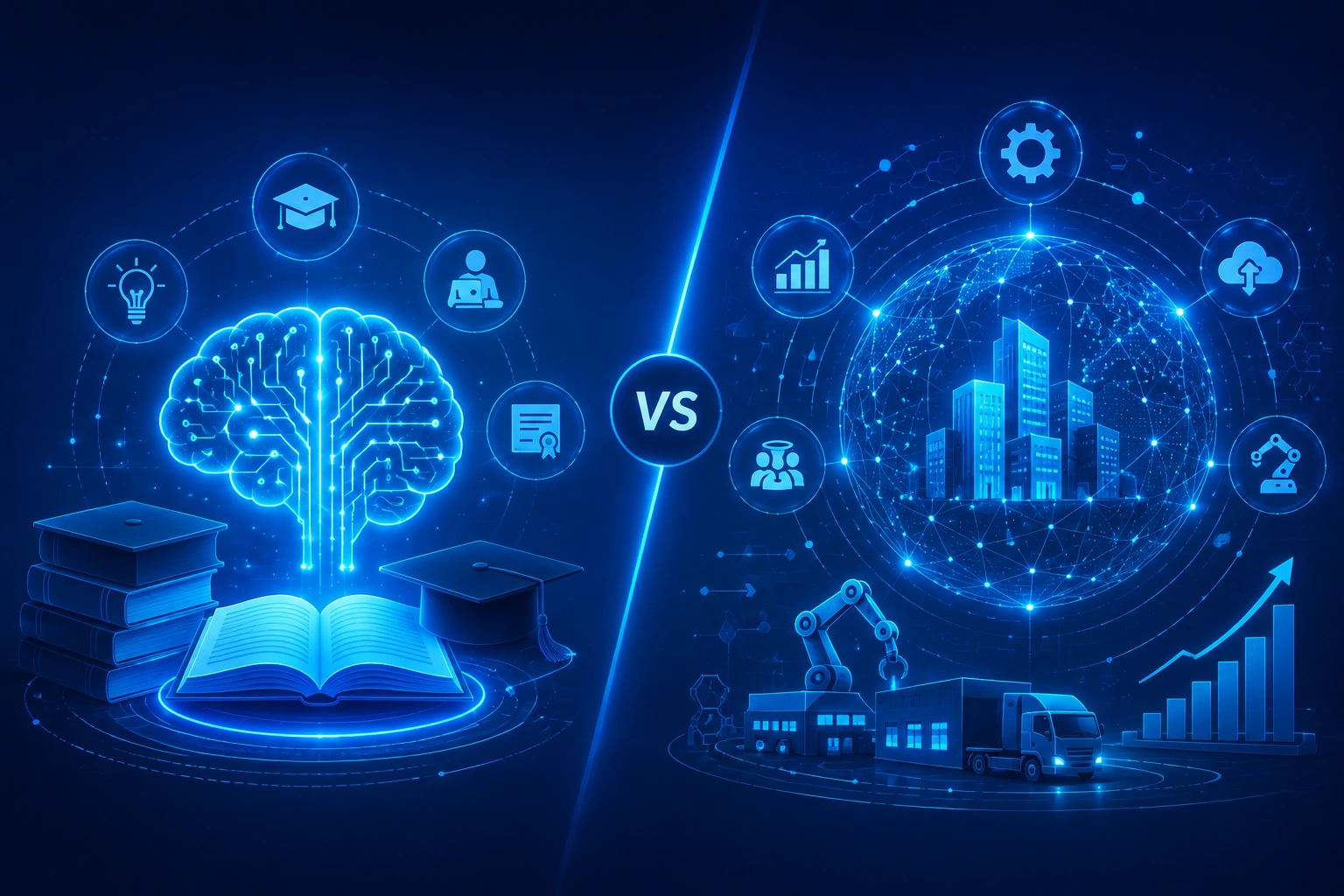
The difference is simple to state. AI training changes your people. AI transformation changes your organisation. Training gives individuals the capability to use AI well in their own work. Transformation redesigns the systems, processes, and ways of working so the organisation itself operates differently. One produces skilled people. The other produces a changed business.
They operate at different levels, on different timescales, and are led by different people. The table below sets them side by side.
Dimension | AI Training | AI Transformation |
|---|---|---|
What it changes | Your people's capability | Your systems, processes, and ways of working |
What it produces | Skilled people who can use AI well | An organisation that operates differently |
Who leads it | Learning leads and department heads | Executive leadership and technical teams |
Typical timescale | Days to weeks per programme | Months to years, in stages |
How it is measured | Skills applied, readiness score | Cost, speed, revenue, and workflow change |
Where it sits at iPF | iPF Academy | iPF Softwares |
The distinction matters because the two are frequently sold and bought as if one substitutes for the other. It does not. A trained workforce with unchanged processes has capability it never fully uses. A transformed process staffed by untrained people is a system waiting to be misused. Value appears only where the two meet.
Confusing them is expensive because it leads organisations into one of two failure modes, and both waste money.
The first is buying transformation before capability exists. An organisation invests in new AI-enabled systems, then finds its people cannot use them well, so the systems deliver nothing. This is the pattern behind the widely reported finding from MIT that 95 percent of enterprise AI pilots produced no measurable business impact, a failure the researchers traced not to the technology but to a learning gap, meaning tools that were never integrated into how people actually work.
The second is training without ever transforming. A workforce learns AI skills, then returns to processes that were never redesigned to use them. The skills sit idle, the productivity gain never materialises, and leadership concludes that training did not work when the real problem was that nothing downstream changed.
The evidence explains why the connection is so important. The World Economic Forum's Future of Jobs Report 2025 found that skills gaps are the single biggest barrier to business transformation, cited by 63 percent of employers, ahead of culture, regulation, and capital. In response, 85 percent of employers plan to prioritise upskilling their workforce as their main strategy. Transformation is what organisations want, the skills gap is what blocks it, and training is what most of them are choosing to close it. For Tanzania, the IMF's finding that scarce skills are a core regional constraint makes the point sharper still.
They connect as a cycle, not a straight line. AI capability in an organisation is not bought once and installed. It is grown in a loop: you assess where you stand, you train your people, they apply that capability to transform how the work is done, and the transformation reveals the next set of skills you need. Then the loop turns again. We call this the AI Capability Loop.
You grow into transformation, you do not buy it
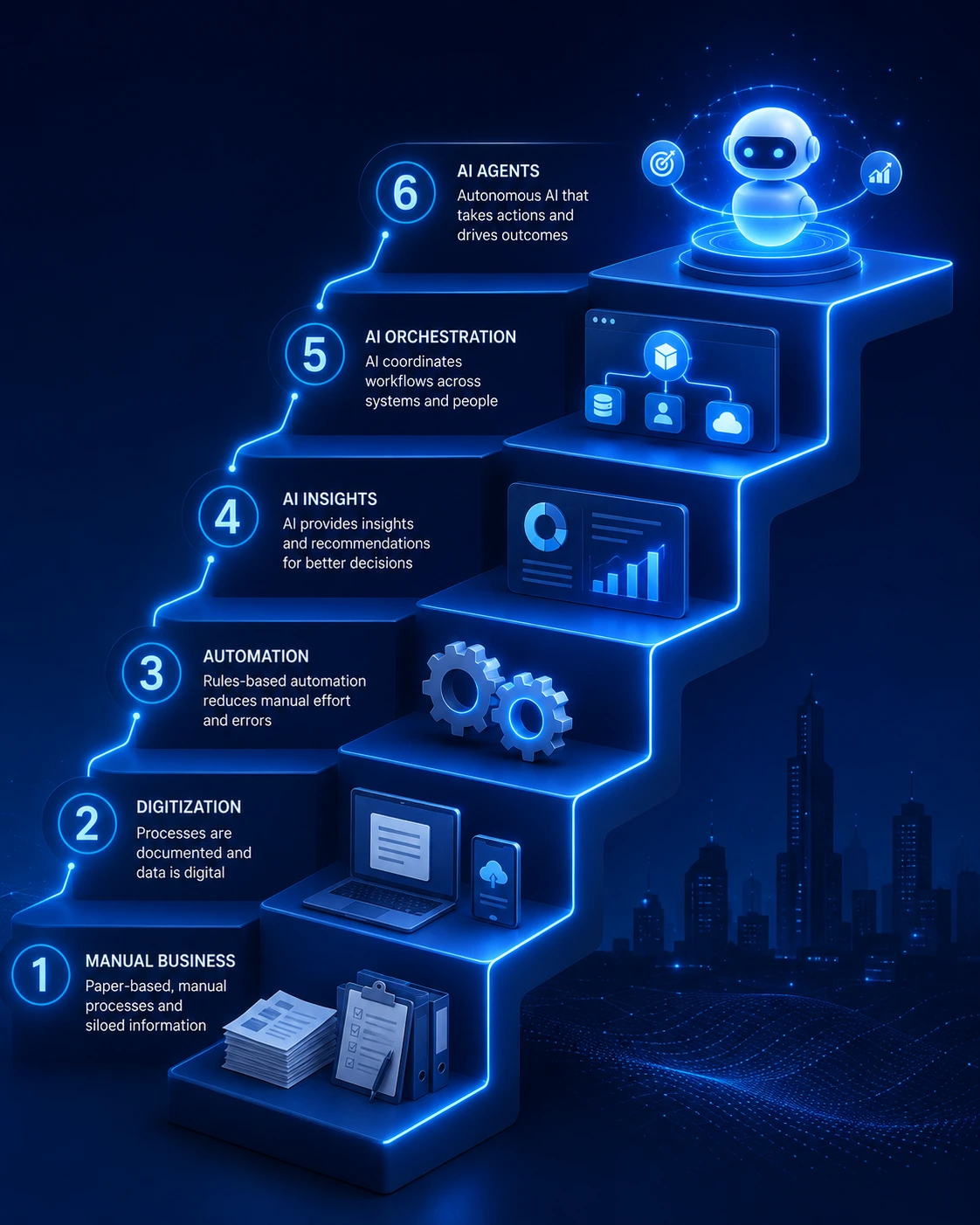
This is the idea most vendors leave out. An organisation cannot purchase its way up its AI maturity. Its people carry it up. iPF Softwares describes that maturity as a six-level ladder, from Manual and Digital through Connected, Automated, AI-Powered, and finally Agentic. Reaching each higher rung requires people who can design, trust, and govern what the systems do. Transformation is the movement up the ladder. Training is the engine that makes the movement possible.
Each turn of the loop moves you up
The loop is not busywork. Each turn produces a real change in how the organisation operates, and it surfaces the next capability gap to close.
Picture a finance team at a mid-sized firm in Dar es Salaam. It starts by assessing where it stands and finds that its people have no working AI skills. So it trains them to draft and check routine financial commentary with AI. Those trained people then transform the monthly reporting process, cutting the time it takes from days to hours. That change immediately reveals the next opportunity, which is deeper analysis rather than drafting, and analysis calls for a different, more advanced set of skills. The team assesses again, trains for analysis, and transforms how it forecasts. One turn of the loop made the next turn both possible and obvious. Progress compounds, and each pass lifts the organisation a rung higher than a one-off tool purchase ever could.
This is why training and transformation are best treated as one ongoing programme rather than two separate purchases.
Almost every organisation needs training before transformation, because transformation depends on capable people, and the skills gap is the most common thing blocking it. Investing in systems while your people cannot use them is how budgets are wasted. Building capability first is how transformation becomes possible.
The honest answer, though, is that the real first step is neither. It is to find out where you actually stand. A readiness assessment shows where your organisation sits on the AI maturity ladder, which tells you what you need next. If your people cannot yet use AI in their work, the answer is training. If they can, but your processes have not been redesigned to use that capability, the answer is transformation. Usually it is both, in that order, and the assessment is what tells you where to begin.
There is a practical trap worth naming. Boards often push for visible transformation because it sounds like decisive action, and leaders feel pressure to answer with a big system or a flagship project. Starting with capability can feel slower by comparison. It is not. Building the skills first is what makes transformation actually land, so it reaches a real result faster than a large project launched over people who cannot yet run it. The quiet route is the quicker one.
Talk to the iPF Academy team
Tell us about your team and goals, and we will recommend the right AI training for you.
Contact UsiPF sits on both sides of this distinction, which is unusual and useful. iPF Academy is the training station on the loop. It builds the capability of the people who will carry an organisation up the ladder. iPF Softwares is the transformation station. It designs and builds the AI systems that change how the organisation operates, with a decade of delivery inside East African banks, insurers, and enterprises, ISO/IEC 27001:2022 certification, and on-premise deployment for regulated environments where data cannot leave the organisation.
The practical benefit of one partner covering both stations is that nothing falls into the gap between them. Training is designed with the transformation it is meant to enable, and transformation is built for people who have been trained to run it. When training and transformation come from disconnected sources, that handoff is exactly where AI initiatives tend to stall. The wider transformation work behind iPF Softwares and the training delivered by iPF Academy are two halves of the same capability loop.
No. AI training builds capability in people, teaching them to use AI in their work. AI transformation changes how the organisation operates, redesigning systems and processes around AI. Training produces skilled people. Transformation produces a changed business. They are connected, because transformation depends on trained people, but they are distinct activities led by different people on different timescales, and treating one as a substitute for the other is a common and costly mistake.
Rarely with success. Transformation depends on people who can use, trust, and govern AI systems, and without training those people do not exist inside the organisation. The World Economic Forum found that skills gaps are the single biggest barrier to business transformation, cited by 63 percent of employers. Buying transformation while ignoring capability is the most direct route to an expensive system that no one uses well, which is a leading cause of failed AI projects.
For most organisations, training comes first, because transformation needs capable people to carry it. The more accurate answer is that a readiness assessment comes first, because it shows where you stand and therefore what you need. If your people cannot yet use AI, train them. If they can but your processes have not changed, transform those processes. In practice most organisations need both, sequenced so that capability is built before it is applied at scale.
No. Training builds capability, but if the organisation's processes are never redesigned to use that capability, the skills sit idle and the return never appears. This is a real failure mode: a well-trained team returning to unchanged ways of working. Training is necessary but not sufficient. It has to be paired with the deliberate transformation of how work is done, which is why the two belong in a single ongoing programme rather than as separate one-off purchases.
They operate on very different timescales. A training programme can shift how people work within days or weeks. Transformation is measured in months and years, because it means changing systems, processes, and habits across an organisation, usually in stages. This difference is one reason the two are confused: leaders expecting the quick payoff of training from a transformation effort become disappointed, while those expecting deep organisational change from a short course are equally let down.
Training is typically led by learning leads and department heads who know what their teams need. Transformation is led by executive leadership and technical teams, because it changes how the whole organisation operates and carries strategic and security implications. Both require leadership sponsorship to succeed. A common breakdown happens when training is treated as an HR task and transformation as an IT task, with no one owning the connection between them.
A smaller organisation should usually start with training and one well-chosen use case, and treat transformation as a direction rather than a single large project. The AI Capability Loop applies at any size. An SME trains a few people, uses AI to change one process, learns from it, and repeats. This staged approach is often more effective for smaller organisations than attempting a large transformation programme, because it builds capability and evidence at a manageable pace.
The clearest way is a structured readiness assessment, which places your organisation on the AI maturity ladder and identifies your specific gaps. This tells you whether your immediate need is training, transformation, or both, and what the sensible next step is. Guessing tends to produce one of the two costly errors: investing in systems your people cannot use, or training people whose work never changes. An assessment replaces the guess with a direction.
AI training and AI transformation are not competing choices. They are two parts of a single journey. Training changes your people. Transformation changes your organisation. And the two connect in a loop, where trained people transform the work, and the transformed work reveals the next skills to build.
Hold on to three ideas. You cannot buy your way up the AI ladder, you grow into it through capable people. The skills gap is the biggest barrier to transformation, which is why training almost always comes first. And the two work best as one continuous programme rather than two disconnected purchases.
iPF covers both halves of that journey, training through iPF Academy and transformation through iPF Softwares. Wherever your organisation sits today, the first move is the same: find out exactly where you stand.
See where your organisation stands on the AI journey
The assessment is free, takes only a short time, and shows you whether your next step is training, transformation, or both.
Take the free AI Readiness Assessment