 AI Training
AI Skills vs AI Tools: What Should Professionals Actually Learn?
Grayson Julius
Last Updated :
20th August 2026

By Grayson Julius
AI Strategist
Share this article with your friends
Quick Answer: The AI skills professionals in Tanzania need are practical, not technical, and most require no coding. They start with AI literacy, meaning a working understanding of what AI can and cannot do, and build into four skills: directing AI with clear instructions, judging and verifying its output, integrating it into real workflows, and using it responsibly with proper data care. The skill that matters most is verification, because it separates a professional who can rely on AI from one who gets caught out by its errors.
The question most Tanzanian professionals are asking about AI is the wrong one. It is not whether AI will take your job. It is whether the colleague next to you, the one who has learned to use AI well, will do your job faster, at lower cost, and with fewer errors than you can. That is the real shift happening in offices in Dar es Salaam, Arusha, and Mwanza right now.
Picture two professionals in the same meeting. Both have used the same AI tool. One says it cannot be trusted. The other has quietly cut hours off their week with it. The difference is not the tool, and it is not intelligence. It is AI literacy and the skills built on top of it. This guide sets out which AI skills every professional in Tanzania needs, why they have become a career issue, and how they differ by profession. It is written by the team behind iPF Academy, drawing on more than a decade of building and using AI systems inside East African organisations.
The AI skills professionals need are the ones that let you get reliable work out of AI tools and fold them into your job safely. They are not the skills of an engineer. You do not need to build models or write code. You need to understand what the tool is, instruct it clearly, check what it gives back, redesign your own tasks around it, and do all of that without exposing sensitive information.
That last point matters in Tanzania specifically, where much professional work touches customer data, financial records, and regulated information. A professional who produces fast output but cannot tell when it is wrong, or who pastes confidential data into the wrong tool, is a risk, not an asset. Real AI skill is the combination of speed and judgment.
AI literacy is the ability to use AI tools sensibly: to understand roughly how they work, judge when their output can be trusted, handle information responsibly, and stay in control of the decisions that matter. It is closer to financial literacy than to computer programming. You do not need to be a banker to manage money well, and you do not need to build an AI system to use one well.
Literacy is the foundation that AI skills stand on. The accountant who knows exactly when to trust an AI summary and when to check the figures is more AI literate than the engineer who trusts every output. Literacy is judgment applied to a tool, and judgment is something every professional already knows how to build.
AI skills have become a career priority because the labour market is repricing them in real time, and Tanzania sits at a point where individual skill is still rare enough to be a genuine advantage.
The global signal is clear. The World Economic Forum’s Future of Jobs Report 2025 finds that AI and big data are the fastest-growing skill set employers are demanding, with technological literacy close behind. In the same report, analytical thinking remains the most sought-after core skill, valued as essential by seven out of ten companies. The two findings belong together: as AI takes over routine tasks, the human ability to question and check its work becomes more valuable.
The scale of change is large. The WEF projects that by 2030 around 170 million new roles will be created and 92 million displaced worldwide, a net gain of 78 million jobs, with 59 percent of the global workforce needing training. Around 39 percent of the core skills workers use today are expected to change. The people who keep and win the good roles are the ones who reskill early.
For Tanzania, this arrives with a local twist. The International Monetary Fund’s 2026 paper Unlocking the Potential: AI in Sub-Saharan Africa ranks the region as the least prepared for AI, with scarce technical skills named as a core constraint. At the national level that is a warning. At the individual level it is an opening: in a market where few professionals have real AI capability, the ones who build it early stand out further. Tanzania is also moving to support the shift, having held its first National AI Forum in Dar es Salaam in July 2025 under an inclusive and ethical AI theme, as covered by The Citizen.
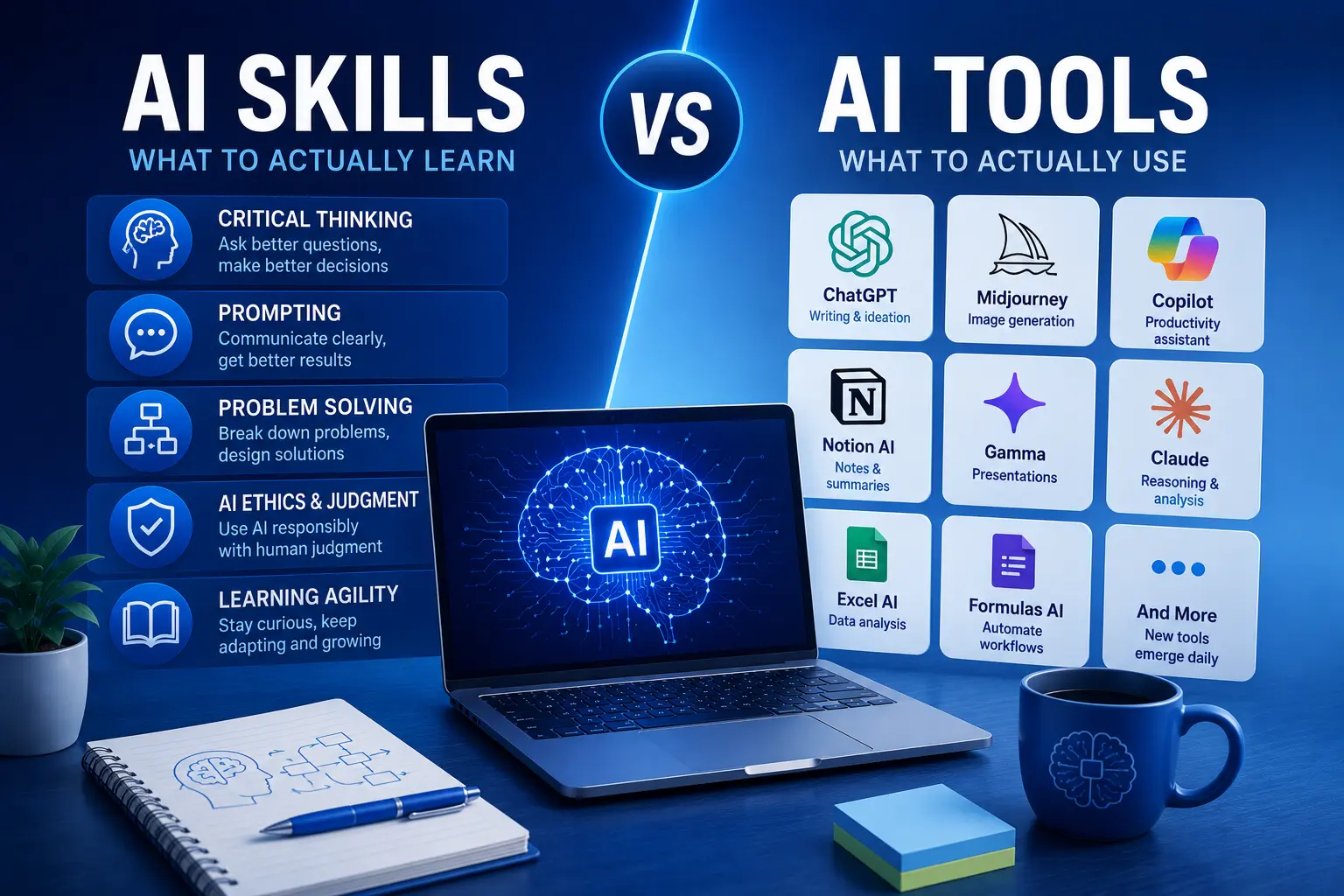
Most guides to AI skills hand you a list of tools. That is the wrong unit. Tools change every few months, and a skill tied to one tool expires with it. The durable skills sit underneath the tools and build on each other. We call this structure the AI Fluency Stack.
The stack rests on a foundation of understanding, has three core skills that build upward, and is held inside a fourth that must be present from the start: responsibility.
Generative AI produces plausible content by predicting a likely response from patterns it learned. It does not look up verified facts, and it does not reason through a problem the way a trained professional does. This one understanding prevents the two most common errors. People without it either trust the tool for things it cannot do, such as producing reliable legal citations, or dismiss it after one bad experience and miss everything it does well. Understanding means knowing the tool is excellent at language tasks like drafting and summarising, and unreliable as a source of specific facts.
Direction is the skill of telling AI clearly what you want. It means giving enough context, showing an example of the output you expect, and being specific about format and audience. Vague instructions produce vague results, which is why so many people conclude AI is not useful when the real problem is the instruction. Direction is learnable in hours.
Discernment is the skill of judging the output, and it matters most. AI produces confident, fluent answers that are sometimes wrong, and it rarely signals which is which. A professional with discernment spots the figure that does not add up, notices the citation that does not exist, and treats every specific fact, figure, name, law, and citation as unverified until confirmed at the source. This is where the analytical thinking the WEF ranks first actually gets used. Most AI training stops after Direction. The professionals who become reliable with AI are the ones who develop Discernment.
Integration is the skill of building AI into how a job gets done, rather than using it as an occasional shortcut. It means looking at a recurring task, deciding which parts AI should handle and which must stay human, and setting up a repeatable way of working that saves time every week. Integration turns a novelty into productivity, and it is where AI skill starts to show up in results a manager can measure.
Responsibility is not a final step. It is the frame around everything else, present from the first day. It means never pasting confidential customer, financial, or personal data into tools not approved for it, checking output for bias before it affects a real decision, keeping human accountability for every decision, and following your organisation’s rules and Tanzania’s data protection law. It also means knowing when not to use AI at all, such as a difficult conversation or a decision with serious consequences for a person.
Talk to the iPF Academy team
Tell us about your team and goals, and we will recommend the right AI training for you.
Contact UsEvery profession needs the whole Fluency Stack, but the skill to prioritise first differs by role, because the cost of getting AI wrong lands differently in each.
Profession | Skill to prioritise first | What it looks like in practice |
|---|---|---|
HR and People leaders | Discernment and Responsibility | Screening applications with AI while auditing for bias and protecting candidate data |
Accounting and finance | Discernment | Drafting analysis and commentary with AI, then verifying every figure before it reaches a report |
Marketing | Direction and Integration | Producing campaign drafts quickly, then shaping them for local audiences and channels |
Executives and managers | Responsibility and Integration | Setting where AI is allowed and redesigning team workflows around it |
Legal | Discernment | Using AI for first-draft research, then checking every authority and clause line by line |
Roles that carry compliance and accuracy risk, such as finance, legal, and HR, must lead with Discernment and Responsibility. Roles built around output volume, such as marketing, gain fastest from Direction and Integration. For HR and People leaders, these skills are already applied to hiring, retention, and performance in the AI for HR Professionals programme. If you lead a department and want to see your team’s gaps before committing budget, a short AI readiness assessment shows where people actually sit.
Three reasons make it timely here. First, national momentum is building: the first National AI Forum in July 2025 and the national AI strategy under development signal that AI is becoming part of how the economy and public services will run. Second, the regulatory environment is real. The Personal Data Protection Act 2022 has been in force since 2023, overseen by the Personal Data Protection Commission, so the consequences of poor data handling are concrete. Third, much professional work in Tanzania runs in two languages, and AI’s ability to move between Swahili and English is useful only to a professional literate enough to check that meaning survives the translation.
You build durable AI skills through applied practice on your own work, not through watching tool demonstrations. Start with understanding by using an AI tool for a low-stakes task and noticing where it excels and where it fails. You will quickly feel the difference between asking it to draft an email, which it does well, and asking it for a specific regulation, which it may invent.
Then add two habits. First, treat every AI output as a draft to be checked rather than an answer to be trusted, which builds Discernment as a reflex. Second, pick one recurring task each month and redesign it around AI, which builds Integration a step at a time. Before you type anything, decide whether the information is safe to share, and default to no when unsure.
Structured training compresses this. Instead of discovering each lesson through your own mistakes over months, a good programme gives you the habits, the boundaries, and practice on real professional tasks from the start. The WEF’s finding is worth holding onto: the most valuable professionals combine technical capability with human skills such as critical thinking, creativity, and judgment. AI skills are a multiplier on professional expertise, not a replacement for it. The decade of AI and digital transformation work behind iPF Softwares shapes how iPF Academy teaches these skills, using examples from real East African organisations.
Start with understanding what AI can and cannot do, then Direction, the skill of giving AI clear instructions with context and examples, because it produces immediate results. Move quickly to Discernment, the skill of checking output for errors, because it is what makes your AI use reliable rather than risky.
No. Knowing how to type a request into a chatbot is one part of one skill. AI literacy includes understanding what the tool can and cannot do, checking its output, protecting sensitive data, and keeping human accountability for decisions. Someone can use an AI tool every day and still lack literacy if they trust everything it produces or paste confidential data into it.
No. AI literacy is closer to financial literacy than to programming. Accountants, lawyers, marketers, and HR professionals become highly capable with AI without any coding. What matters is building the skills in the Fluency Stack through structured practice on your own work.
For a working professional, the practical foundation can be built in weeks rather than years, because you are applying judgment to familiar work, not learning a new technical discipline. Direction can be learned in hours. Discernment and Integration take steady practice over a few weeks, and structured training shortens that further.
The evidence points to change rather than wholesale replacement. The WEF projects a net global increase of 78 million jobs by 2030, with many roles reshaped rather than removed. The clearer risk is being outperformed by professionals who use AI well.
No. AI and big data literacy is now among the fastest-growing skills across every function. The professionals who gain most are often outside technical roles, because AI removes routine work from document-heavy, analysis-heavy jobs.
Prompt engineering is the practice of writing effective instructions for AI, which in the Fluency Stack is Direction. Professionals need it at a practical level: clear context, examples, and format requirements. They do not need the specialised technical version marketed as a standalone career.
Yes. Because it is a set of learnable habits, it can be taught across a team so everyone shares the same standards for verification, data handling, and accountability. That matters because one careless team member can create risk for the whole organisation.
The tools change constantly, but the core skills do not. Understanding, directing, checking, integrating, and using AI responsibly apply to whatever tool arrives next. A professional who learns only the buttons of today’s tool has to relearn everything when it updates. One who builds the underlying skills adapts in minutes.
AI skills are no longer optional for professionals in Tanzania who intend to stay competitive, but they are well within reach. They are practical, mostly non-technical, and learnable in a sensible order.
AI literacy, meaning a working understanding of what AI can and cannot do, is the foundation.
The most important skill is Discernment: the judgment to know what to trust.
Responsibility frames everything, especially with Tanzania’s data protection law in force.
Skills, not tools, are what last, and they multiply your professional expertise rather than replace it.
iPF Academy makes that path practical, taught by a team that builds the systems it teaches.
RELATED ARTICLES
AI TrainingGrayson Julius
 AI Training
Grayson Julius
 AI Training
Grayson Julius