 AI Training
Why AI Training Is Becoming Essential for Tanzania's Workforce
Grayson Julius
Last Updated :
13th November 2026
By Grayson Julius
AI Strategist
Share this article with your friends
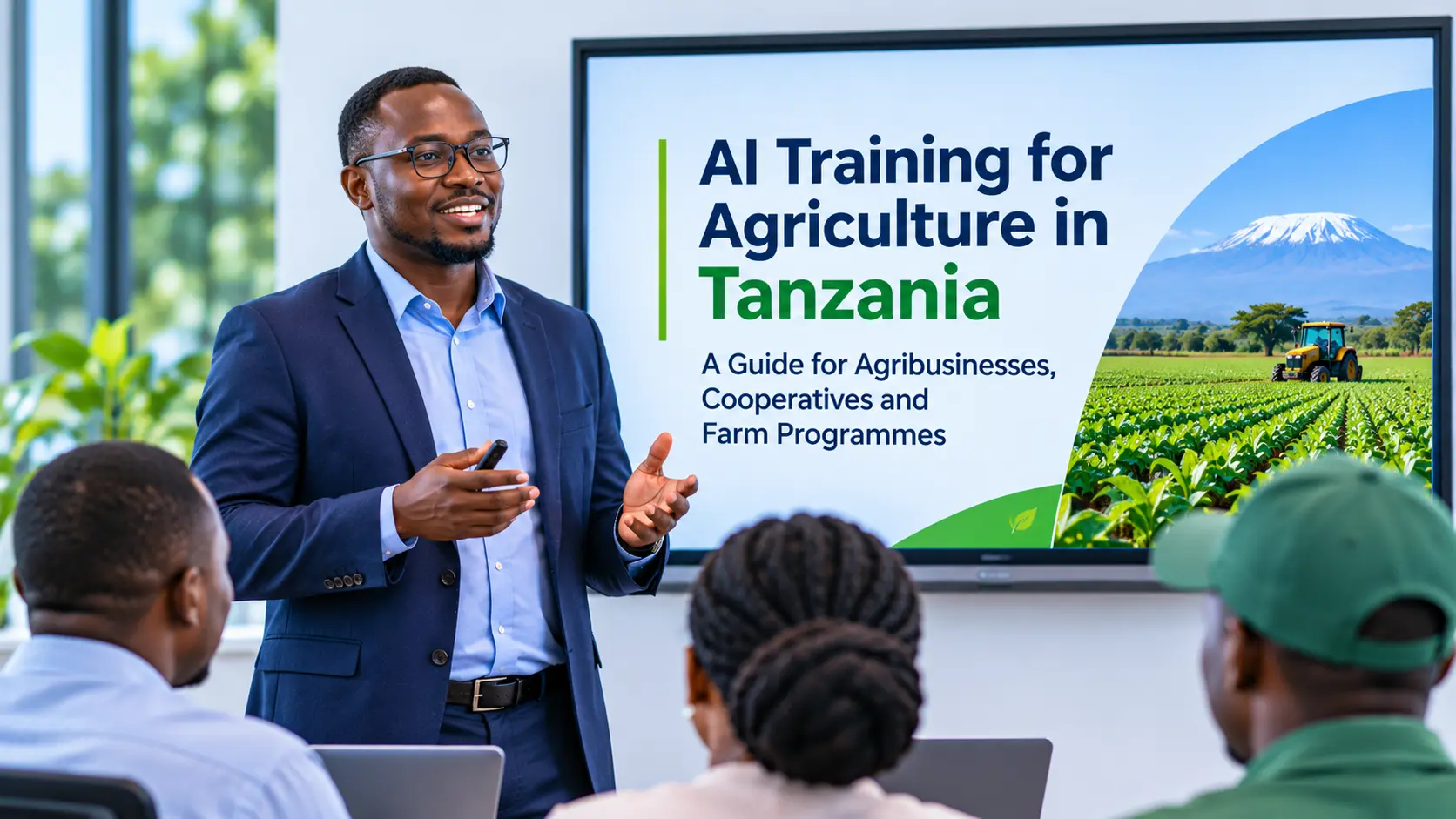
Most talk about AI in farming focuses on drones, sensors and apps for farmers. In Tanzania, much of the daily work that decides whether a harvest earns money happens elsewhere. It happens in the office of a cooperative, the export desk of a horticulture company, or the reporting team of an agriculture programme. AI training for agriculture in Tanzania starts with these people: the staff who turn field information into buyer contracts, reports and decisions.
This guide explains where AI helps agricultural organisations today, what staff need to learn, and the risks to manage along the way.
Agriculture is still Tanzania’s largest employer. The National Bureau of Statistics’ Integrated Labour Force Survey 2024 found that agriculture employs 54.2 percent of the workforce, down from 60.4 percent in 2020/21. World Bank data puts agriculture at about 23 percent of GDP in 2024.
The government’s Agenda 10/30, launched in April 2022, aims for 10 percent annual growth in the sector by 2030. Digital tools are part of that plan. The Ministry of Agriculture launched the e-Kilimo digital extension system in July 2025, and its M-Kilimo service already connects millions of registered farmers with extension workers.
Tools alone have not been enough, though. Al Jazeera reported in November 2026 that many smallholder farmers struggle to benefit from these services because of poor training and slow responses. The lesson applies inside organisations too: a new system only pays off when people know how to use it well. Generic AI courses rarely cover the realities of agricultural work: seasonal cash flow, buyer standards, cooperative governance, Swahili and English working side by side, and farmer data.
AI training in this sector is mostly for organisations, not individual farmers. The teams that benefit most include:
Agribusinesses and processors managing procurement, quality records and sales.
Horticulture and crop exporters preparing buyer documentation and market reports.
Agricultural cooperatives and unions keeping member records, collection data and meeting minutes.
Input suppliers and distributors handling orders, stock and dealer networks.
Agricultural lenders and insurers reviewing farmer applications and claims.
NGOs and development programmes running farmer projects and reporting to donors.
Extension and local government teams preparing farmer guidance and field reports.
This map links common roles in agricultural organisations to everyday AI tasks, what training should cover, and the main risk to manage. Use it to decide who to train first.
Role | Everyday task AI can support | What training should cover | Risk to manage |
|---|---|---|---|
Cooperative manager or secretary | Drafting meeting minutes, member notices and reports to the union | Writing clear prompts, Swahili and English drafting, checking figures | Member personal data entering AI tools |
Procurement or collection officer | Summarising collection records and spotting gaps in spreadsheets | Using AI with spreadsheets, checking calculations | Wrong totals passed on without checking |
Export and sales staff | Drafting buyer emails, product sheets and market summaries | Tone for international buyers, fact checking, using approved sources | Claims about quality or certification that are not true |
Programme and M&E officer | Summarising field reports and drafting donor reports | Summarising long documents, structuring reports, citing data | Beneficiary data, including children, in AI tools |
Extension and training staff | Turning technical guidance into simple farmer messages in Swahili | Plain-language rewriting, checking advice against official guidance | AI advice that does not fit local soils, crops or pesticide rules |
Credit and insurance officers | Summarising applications and preparing review notes | Keeping decisions with people, documenting reasons | Fully automated decisions about farmers |
Managers and leadership | Reading reports faster and preparing board papers | Setting AI rules, choosing tools, measuring results | Adopting AI without a policy |
You don’t need specialised farm technology to start. Most early gains come from general AI assistants used well by trained staff.
Faster reporting. Programme teams can turn a pile of field visit notes into a structured draft report, then edit and verify it. The time saved goes into checking facts and following up with farmers.
Better buyer communication. Export and sales teams can draft clear, professional emails and product descriptions for buyers in other countries. Staff still check every claim about grade, volume and certification before anything is sent.
Clearer farmer messages. Extension teams can rewrite technical guidance into short, simple Swahili messages for SMS, WhatsApp groups or radio scripts. A qualified officer checks each message before it goes out.
Sharper use of data. Collection and sales records often sit in spreadsheets nobody has time to analyse. With training, staff can use AI to summarise trends, find missing entries and prepare charts for management. They then confirm the numbers against the source data.
Ready for national plans. Tanzania’s draft National AI Strategy, published for consultation by the Ministry of Communication and Information Technology in 2025, names agriculture among its priority areas. Organisations that build staff skills now will be better placed as national systems and programmes grow.
Farmer registries, cooperative member lists and loan files hold names, phone numbers, ID numbers, locations and mobile money details. Under Tanzania’s Personal Data Protection Act, putting that information into an AI tool counts as processing personal data, and financial and children’s data are treated as sensitive. Read our guide to the Personal Data Protection Act and AI before your team uses AI on any farmer or member records.
General AI tools are trained mostly on content from outside East Africa. They can suggest crop varieties, planting dates or input rates that don’t suit local soils, rainfall or approved products. Any farming advice drafted with AI must be checked by a qualified officer against official guidance, such as Tanzania Agricultural Research Institute recommendations and the rules of the Tanzania Plant Health and Pesticides Authority, before it reaches farmers.
Lenders and insurers may want AI to score applications or claims. Decisions that affect a farmer’s livelihood should stay with a person who can explain them. Use AI to prepare and summarise, not to decide.
Not all AI training fits this sector. Before you commit, check that a programme does these things:
Built around roles. A cooperative secretary and an export manager need different skills. Training should match the Agriculture AI Training Map above, not a single generic syllabus.
Uses your own documents. Staff learn fastest on their real reports, spreadsheets and buyer emails, with personal data removed.
Works in Swahili and English. Much agricultural work moves between both languages. Training should practise both and teach staff to check translations.
Covers data protection. Every session should include what may and may not go into an AI tool.
Fits field conditions. Staff often work from phones with limited connectivity, so training should cover mobile use, not just desktop tools.
Sets measures before it starts. Agree on two or three practical measures, such as time to produce a monthly report, then check them after training.
These principles apply across sectors. Our guide to corporate AI training for organisations in Tanzania explains how iPF Academy tailors training to each organisation’s teams, sector and goals.
Start with one team and one task, not the whole organisation. Many agricultural organisations begin with reporting, because it takes a lot of staff time and the results are easy to check. Once that works, expand to buyer communication, data analysis and farmer messaging.
Before choosing what to train, it helps to know where your organisation stands today: how you use digital tools, how your data is organised, and how ready your teams are for AI.
It is useful for both. Small cooperatives often gain most from simple uses such as drafting minutes, notices and reports, because they have few staff to share the paperwork.
Most AI benefits reach farmers through the organisations that serve them. Training extension staff, cooperative leaders and programme teams usually has a wider effect than training individual farmers first.
Many widely used AI tools can read and write Swahili. Quality varies, so staff should check every output, especially technical farming terms, before using it.
No. Most organisations start with general AI assistants and the documents they already have. Specialised tools make more sense once staff have basic skills and clear use cases.
AI training for agriculture in Tanzania works best when it starts with the people who run the business of farming: managers, cooperative leaders, export teams, programme staff and extension officers. With the right skills and clear rules on data, these teams can save time, communicate better and make sharper decisions.
Take the free AI Readiness Assessment to see where your organisation stands
Talk to the iPF Academy team
Tell us about your team and goals, and we will recommend the right AI training for you.
Contact Us