 AI Training
How to Prepare Employees for AI Adoption
Grayson Julius
Last Updated :
13th November 2026
By Grayson Julius
AI Strategist
Share this article with your friends
An HR officer pastes twenty CVs into ChatGPT to build a shortlist. An accountant uploads a client’s ledger to an AI tool to find reconciliation errors. Both save hours. Both may also be handling personal data in ways the Personal Data Protection Act in Tanzania regulates. This guide explains what the Act says, where everyday AI use meets it, and how to check data before it goes into any AI tool.
The short answer. You can use AI tools at work in Tanzania. Once personal data goes into those tools, though, the Personal Data Protection Act applies. Your organisation needs a lawful purpose for that data. Sensitive data needs extra care. Data sent to a provider outside Tanzania must meet the Act’s transfer rules. This article explains the law in general terms and is not legal advice for your specific situation.
The Personal Data Protection Act No. 11 of 2022 is Tanzania’s first comprehensive data protection law. It came into force on 1 May 2023. It builds on the right to privacy in Article 16 of the Constitution, and it sets minimum rules for how public and private bodies collect and process personal data.
Two sets of Regulations made in 2023 add the detail. One covers collecting and processing personal data. The other covers how complaints are settled. The Personal Data Protection Commission (PDPC) enforces the Act. It was officially launched on 3 April 2024, and it registers organisations, handles complaints and investigates breaches.
The Act separates two kinds of information:
Personal data. Any information about an identified or identifiable person, such as a name, phone number, ID number, address or employee record.
Sensitive personal data. A stricter category. It includes health data, genetic and biometric data, data about children, financial transaction data, and data revealing ethnic origin, religion or political views. Processing this kind of data generally needs the person’s prior written consent, unless a specific exception applies.
The Act defines processing broadly. Collecting, recording, storing, analysing, sharing and transferring data all count. When someone types a client’s name and account history into an AI chat window, the organisation is processing that client’s personal data. Whether the tool is free or paid makes no difference.
The person typing is usually acting for the organisation. That makes the organisation the data controller, because it decides why and how the data is used. The AI provider usually acts as a data processor, handling the data on the organisation’s behalf. Under the Act, the controller stays responsible for what happens to the data, including what happens inside the AI tool.
This is the point most AI guidance misses. The risk is not the AI tool itself. The risk is personal data leaving your organisation’s control without a lawful purpose, a contract or a transfer basis.
1. Registration and purpose
Under section 15 of the Act and regulation 4 of the 2023 Collection and Processing Regulations, an organisation must be registered with the Commission before it collects or processes personal data. A registration certificate is valid for five years. Registration describes what data you process and why. If your team starts using AI on customer or employee data for a new purpose, check that the purpose fits what you registered and what you told the people concerned.
2. Sensitive personal data
Health records, children’s data, biometric data and financial transaction data all carry stricter rules. A clinic pasting patient notes into a public chatbot to draft discharge letters is processing health data. A school using AI on pupil records is processing children’s data. In both cases the general rule is prior written consent, and the safer default is to keep this data out of general-purpose AI tools completely.
3. Sending data outside Tanzania
Most widely used AI tools are run by companies based outside Tanzania, so their servers are usually abroad as well. Typing personal data into them is likely to count as a transfer outside the country. Section 31 of the Act allows transfers to countries with adequate data protection laws. Section 32 sets stricter conditions for countries without them. The 2023 Regulations also require an application to the Commission for permission before personal data is transferred abroad.
For most organisations this is the biggest gap. Few teams that use AI tools daily have asked whether those tools send personal data across borders.
4. Decisions made by AI
The Act gives people the right not to be subject to decisions based solely on automated processing when those decisions significantly affect them. Where processing is automated, the controller must explain the logic behind the decision and how any harm will be addressed. That matters if a bank uses AI to score loan applicants, or HR uses it to reject candidates. Keep a person in the decision, and make sure that person can explain the outcome.
The Paste Test: Check Before You Put Data Into an AI Tool
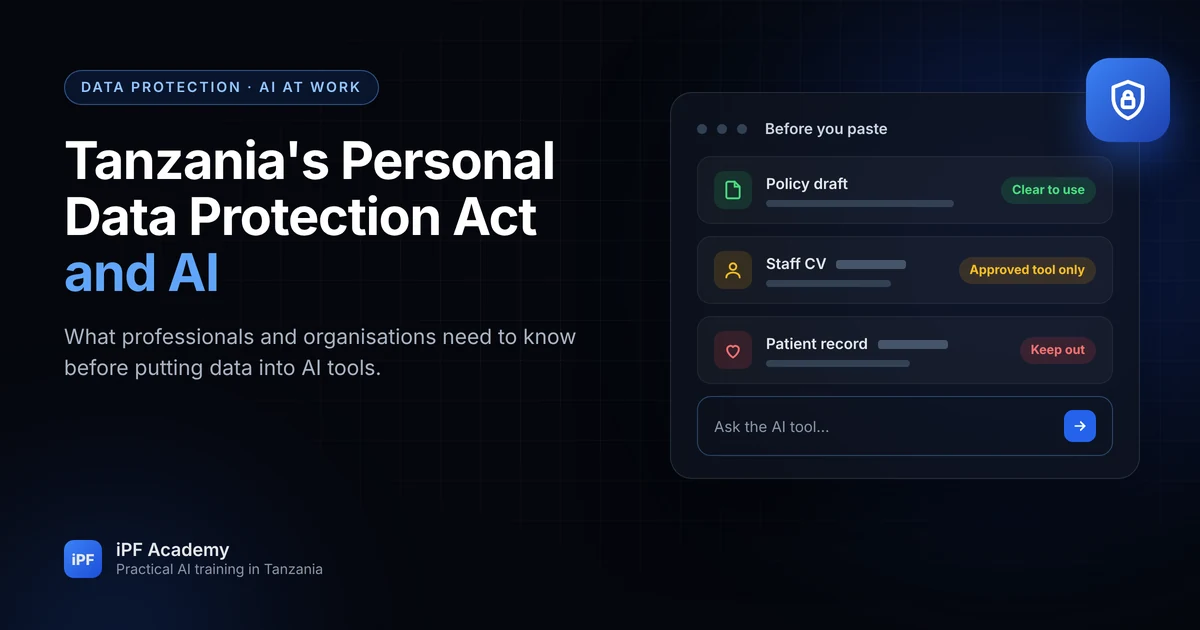
Before anyone on your team pastes, uploads or types information into an AI tool, they can sort it into one of three categories. The test takes seconds, and it catches most of the problems described above.
Category | What it looks like | What to do |
|---|---|---|
Clear to use | No information about any identifiable person. Policy drafts, generic templates, published reports, anonymised figures. | Use any tool your organisation allows. |
Use with an approved tool only | Ordinary personal data. Names, contact details, CVs, staff records, client correspondence. | Use only a tool your organisation has approved, with a contract that covers data handling and a lawful transfer basis. Remove names and identifiers where the task does not need them. |
Keep out | Sensitive personal data. Health records, children’s data, biometric data, financial transaction data, beliefs and ethnic origin. | Do not put this into general AI tools. Use it only where written consent, a lawful basis and a transfer permit are all confirmed. |
The quickest improvement is often to remove identifiers first. “Summarise these complaints” works just as well when customer names are replaced with Customer A, Customer B and Customer C. Be careful, though. Data that can still be linked back to a person is still personal data.
HR teams. Shortlisting CVs with AI is processing applicants’ personal data. Some CVs include dates of birth, photos or health notes, which raises the risk further. Remove details the task does not need, use an approved tool, and keep the final shortlisting decision with a person.
Accountants and finance teams. Client ledgers, payroll files and mobile money statements contain financial transaction data, which the Act treats as sensitive. Use AI on summaries and anonymised extracts, not raw client files.
NGOs. Beneficiary lists often include children, health status and location. Donor reporting tasks can usually be done on aggregated figures, which keeps beneficiary data out of the tool.
Banks and insurers. Credit scoring and claims triage are clear examples of automated decisions with significant effects. These uses need documented logic, human review and a way for customers to challenge the outcome.
Lawyers. Client files combine personal data with professional confidentiality obligations. Treat any client-identifying material as “keep out” unless your firm has approved the tool and its terms.
Compliance does not mean banning AI. It means deciding how AI is used, and making sure everyone knows the rules. Five steps cover most of it:
Map current AI use. Ask each team which tools they use and what data they put into them. Most organisations find more use than they expected.
Approve specific tools. Check each provider’s terms on data storage, data location and whether your inputs are used to train its models. On some consumer plans, what you type can be used to improve the model unless you switch that off. Business plans usually come with stronger contractual terms.
Write a short AI use policy. Base it on the Paste Test. One page that staff actually read is worth more than a long policy nobody opens.
Confirm your obligations under the Act. Check your registration with the Commission, whether you have a data protection officer, and whether any AI tool involves a transfer that needs permission.
Train your people. Policies fail when staff do not understand why the rules exist. Training on real tasks, using your own documents and workflows, is what changes daily behaviour.
The Personal Data Protection Act in Tanzania does not stand in the way of AI at work. It asks organisations to know what data they hold, why they use it, and where it goes. Teams that understand those three questions can use AI with confidence, and teams that don’t are taking risks without realising it.
iPF Academy’s training is practitioner-led and tailored to each organisation, so data protection under the Act can be built into how your team learns to use AI on its own work.