 AI Training
AI Skills Every Professional in Tanzania Needs
Grayson Julius
Last Updated :
2nd October 2026
By Grayson Julius
AI Strategist
Share this article with your friends
Quick Answer: The main AI risks in HR are biased hiring decisions, breaches of the Personal Data Protection Act, loss of employee confidentiality, confidently wrong AI output, and over-reliance that removes human judgement. Each risk is manageable. The control is the same across all of them: a human reviews every decision, and no personal data enters a tool that cannot protect it.
AI makes HR work faster, but HR is also where AI can do the most damage if it is used carelessly. A biased screening tool can quietly discriminate against half your applicants. A single pasted file can breach data protection law. A confident wrong answer can end up in a disciplinary letter. The AI risks HR professionals need to understand are not reasons to avoid the technology. They are the specific things to control so that AI stays an asset and never becomes a liability.
This guide names each risk plainly, shows how it actually shows up in a Tanzanian HR department, and gives you the control for each one. It is written to be used as a checklist, not read once and forgotten.
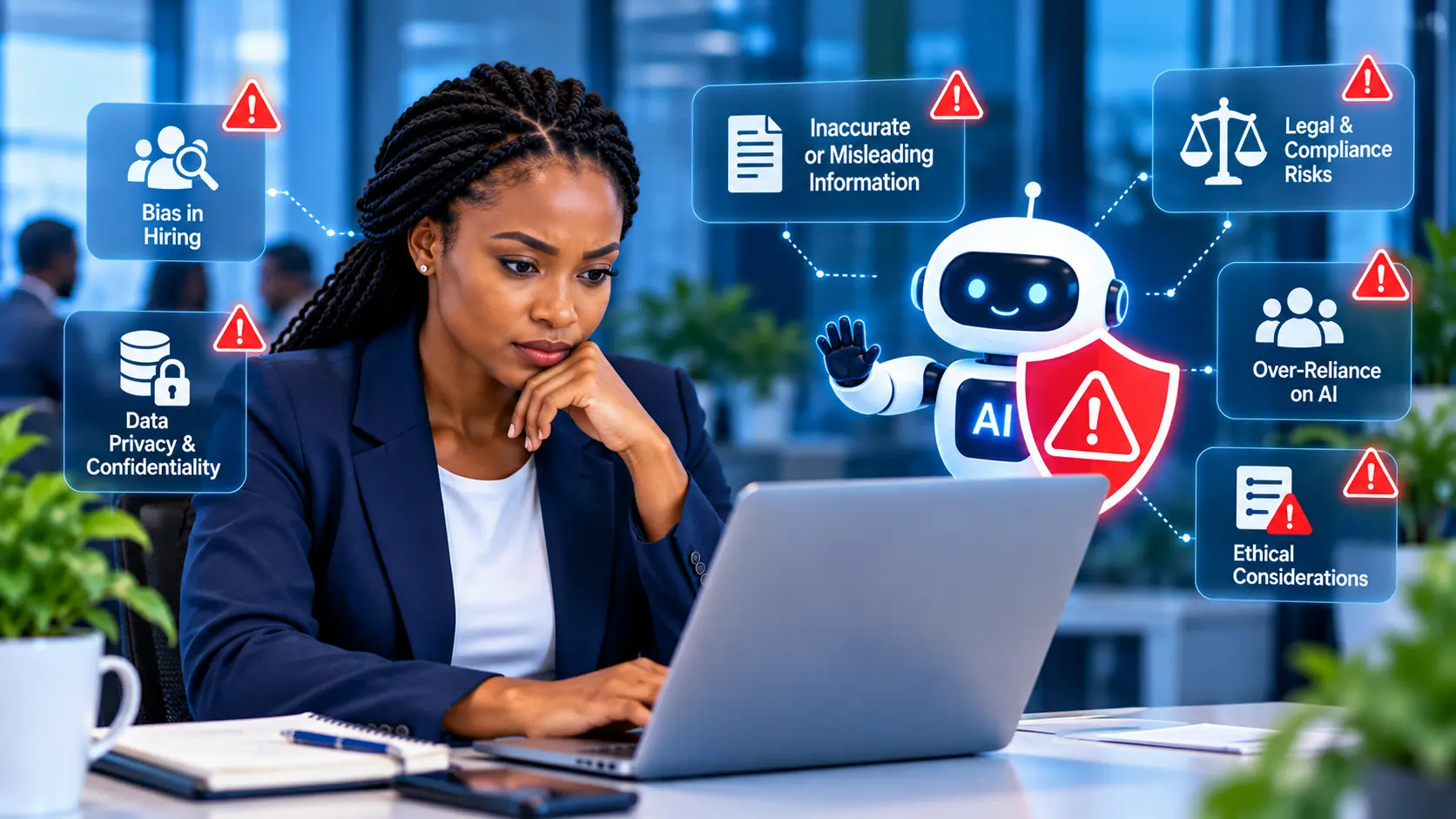
There are five that matter most in day-to-day HR work.
1. Bias and discrimination in hiring. AI trained on past hiring data learns past preferences, including the unfair ones. The most cited example is Amazon's experimental recruiting tool. As Reuters reported in 2018, the tool was trained on a decade of mostly male resumes and taught itself to prefer male candidates, penalising resumes that included the word "women's" and downgrading graduates of two all-women's colleges. Amazon scrapped it. The lesson for HR is permanent: an AI ranking tool can discriminate without anyone intending it to. hrreporter
2. Breaching the Personal Data Protection Act. Employee data is protected personal data. Pasting it into a public tool that processes it abroad can breach the Act's rules on consent, minimisation, and cross-border transfer.
3. Loss of confidentiality. HR handles the organisation's most private information. Salary, medical notes, grievances, and disciplinary history are not data to be typed into a public chatbot, where you no longer control where it goes.
4. Confidently wrong output. AI states incorrect facts with the same fluency as correct ones. A wrong policy interpretation or an invented figure can cause real harm when it reaches an employee.
5. Over-reliance. The subtle risk. When AI drafts everything, the temptation is to stop checking. The moment HR stops reading the output, the risk of every item above rises sharply.
Serious enough to be the risk HR must manage most actively, because the harm is both unfair and unlawful. Discriminating against applicants on protected grounds conflicts with the fairness principles in Tanzania's employment and labour relations law, and it damages the organisation's reputation and talent pool at the same time.
Bias enters through the data. If an AI tool learns from who you hired before, it reproduces whatever pattern was in that history, including any under-representation of women or of people from certain regions or backgrounds. It does this invisibly, which is what makes it dangerous.
The controls are practical:
Never let AI make the final shortlist alone. Use it to organise and summarise applications, then make the selection yourself.
Check the output for patterns. If a tool's recommendations skew consistently in one direction, stop and investigate.
Keep the criteria explicit. Score against the actual job requirements, not a vague "best fit" the tool defines on its own.
Keep a human record of why each candidate advanced. If you cannot explain a decision, you cannot defend it.
Keep this where your HR team can see it. It turns five abstract risks into five concrete habits.
Risk | How it shows up in HR | The control that prevents it |
|---|---|---|
Bias in hiring | AI ranking skews against a group | Human makes every shortlist; check output for patterns |
PDPA breach | Employee data sent to tools abroad | De-identify; use approved tools; know where data goes |
Confidentiality loss | Salary or medical data pasted into public tools | Keep sensitive records in secure, approved systems only |
Wrong output | Invented figure or misread policy in a letter | Verify every fact and number against the source |
Over-reliance | HR stops checking AI output | Keep the human-review step mandatory, never optional |
Caption: The HR AI Risk Register maps each risk to how it appears in real HR work and the single control that prevents it.
What Does the Personal Data Protection Act Require of HR?
The Personal Data Protection Act, 2022, is Tanzania's first comprehensive data protection law. It took effect on 1 May 2023, with its regulations following in July 2023, and it is enforced by the Personal Data Protection Commission. For HR, four duties matter most when AI enters the picture.
Lawful basis and consent. Personal data must be processed on a lawful basis, and sensitive personal data generally requires prior consent. Feeding an employee's data into a new AI tool is a new processing activity.
Data minimisation and purpose limitation. Collect and use only what the task needs. Pasting a full personnel file to answer one question fails this test.
A Data Protection Officer. The Act requires controllers and processors to appoint a Data Protection Officer. In practice, HR should know who that person is and involve them before adopting AI tools.
Controls on cross-border transfer. The Act regulates sending personal data outside Tanzania. Many public AI tools do exactly that by default, which is why de-identification matters so much.
None of this blocks AI in HR. It sets the conditions. De-identify, minimise, use approved tools, and involve your Data Protection Officer, and you can use AI while staying inside the law.
The goal is controlled use, not avoidance. The organisations that get hurt are the ones using AI with no rules at all, not the ones using it carefully.
The core controls are the same ones that appear throughout this cluster, applied with discipline:
A human decides, every time, on anything affecting a person's job or record.
No personal data enters a tool that cannot protect it.
Verify every fact, figure, and policy reading before it is used.
Train the whole team on these controls, so good practice is shared rather than accidental.
That last point is where most risk is actually removed. A team that has been trained to spot bias, protect data, and verify output makes far fewer costly mistakes than individuals learning alone. See how the AI for HR programme covers safe, compliant AI use for HR teams: AI for HR at iPF Academy.
Yes. AI trained on past hiring data can reproduce past bias, as Amazon's scrapped recruiting tool showed when it learned to favour male candidates. The risk is real but manageable: never let AI make the final shortlist alone, and check its recommendations for patterns that skew against any group.
It is legal when you follow the Personal Data Protection Act, 2022. That means a lawful basis for processing, data minimisation, and care with transfers outside Tanzania. Using identifiable employee data in a public tool without these safeguards can breach the Act, which is enforced by the Personal Data Protection Commission.
Over-reliance is the one that enables all the others. When HR stops reviewing AI output, biased shortlists, wrong figures, and data breaches slip through unnoticed. Keeping human review mandatory on every decision is the control that holds the rest in place.
Set a clear rule that no names, ID numbers, salaries, medical notes, or disciplinary records are pasted into public tools. De-identify data before analysis, keep sensitive records in approved systems, and involve your Data Protection Officer before adopting any new tool
Transparency is good practice and supports the fairness and consent principles in the Personal Data Protection Act. Employees should understand that AI assists with processing, that a human makes the decisions, and how their data is handled. This is covered further in the responsible-AI guide.
Yes. AI can misread a policy or invent a rule that does not exist, and state it confidently. Never let AI answer a staff policy question without an HR professional checking the reply against the actual policy document first.
The AI risks HR professionals need to understand are specific and controllable: bias in hiring, breaches of the Personal Data Protection Act, lost confidentiality, confidently wrong output, and over-reliance. Each one has a clear control, and the controls overlap.
Hold onto three principles:
A human decides on anything that affects a person.
Protect the data, because HR data is the most sensitive data you hold.
Verify before you trust, every time.
Managed this way, AI stays a tool that serves your HR team rather than a risk that exposes it. To build these controls into how your team works, explore the AI for HR programme: AI for HR at iPF Academy.
RELATED ARTICLES