 AI Training
How Much Does AI Training Cost in Tanzania?
Grayson Julius
Last Updated :
2nd October 2026
By Grayson Julius
AI Strategist
Share this article with your friends
Quick Answer: HR professionals use AI to draft documents, summarise long text, prepare for meetings, and answer routine employee questions faster. AI assists with the work, but the HR professional still makes every decision that affects pay, discipline, hiring, or an employee's record. The rule is simple: let AI produce the first draft, then verify and own the outcome.
If you run HR in a Tanzanian company, your week is full of writing and reading. You draft job adverts and offer letters. You read stacks of CVs. You answer the same leave and benefits questions again and again. You prepare disciplinary paperwork, onboarding plans, and board reports.
AI for HR professionals is useful because it takes the slow first draft off your desk and hands it back in minutes, so your judgement goes where it actually matters.
This guide shows you where AI helps in real HR work, where it must not be trusted, and how to start this week without putting employee data or your compliance at risk. The examples are built for Tanzanian HR teams working under the Employment and Labour Relations Act and the Personal Data Protection Act, not a generic office somewhere else.
AI for HR professionals is not a robot that hires people. In practice it is a writing and reading assistant that sits beside you. You ask it to draft, summarise, rewrite, or explain. It produces a starting point. You correct it and decide what happens next.
The useful mental model is AI assists, you decide. AI can write a disciplinary letter. Only you can decide whether the employee is disciplined. AI can rank CVs against a job description. Only you can decide who gets the interview. Keep that line clear and almost every use becomes safe and productive.
Globally, this shift is already measurable. The World Economic Forum's Future of Jobs Report 2025 found that 39% of workers' core skills will change by 2030, down from 44% in 2023, and that 59% of the global workforce will need reskilling or upskilling by 2030. HR sits at the centre of that change, because HR is the function that trains everyone else.
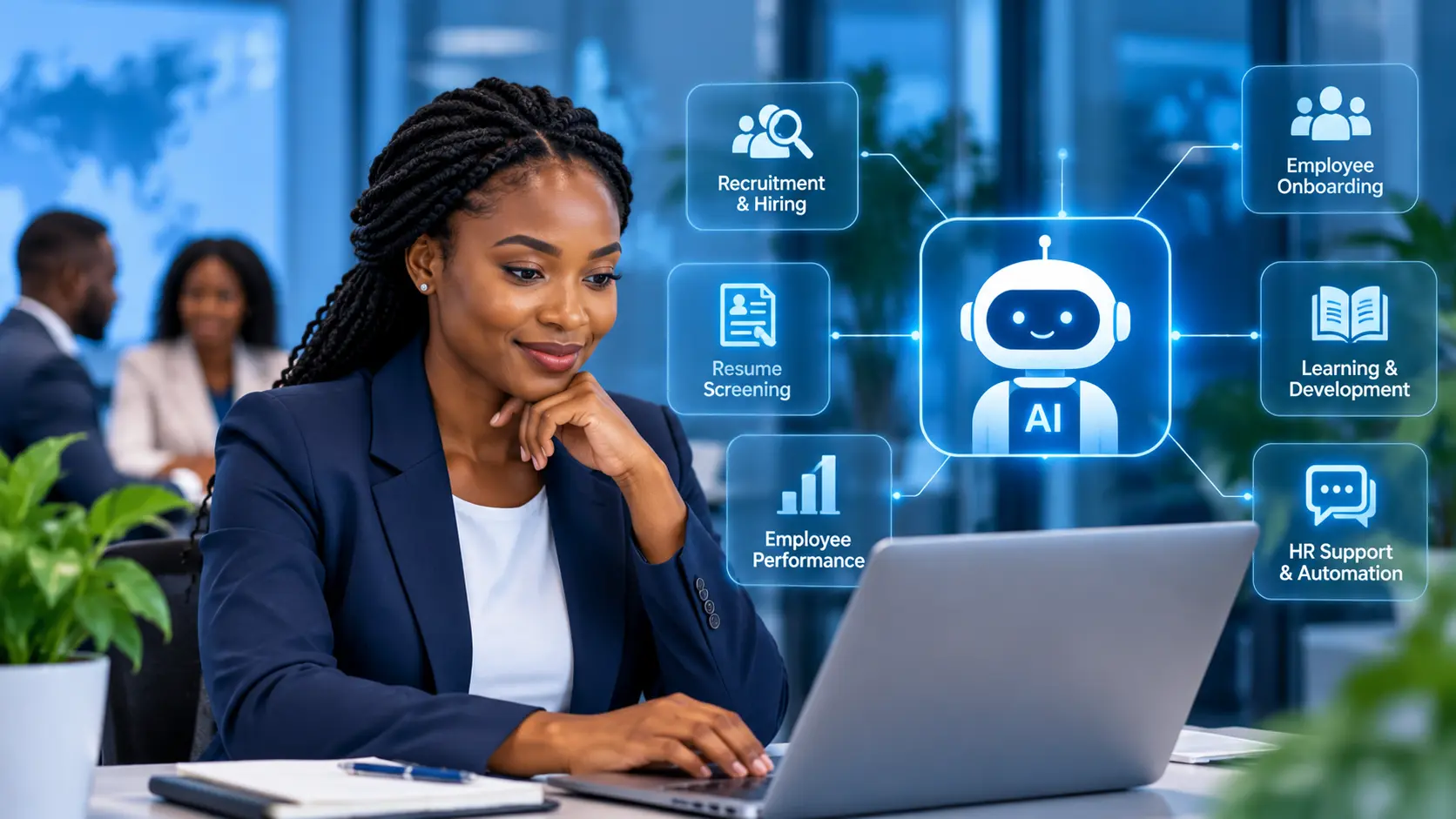
Four kinds of task repeat across almost every HR role. AI helps with all four.
Drafting. Job descriptions, job adverts, offer letters, policy sections, internal announcements, interview question sets, and training outlines. You give AI the role, the level, and your house style. It returns a clean first draft in English or Swahili. You edit for accuracy and local law.
Summarising. A 40-page policy document, a long CV, a set of interview notes, or hundreds of open-text answers from a staff survey. AI compresses them into the few points you need, so you read the summary and only open the full text when something matters.
Preparing. Onboarding checklists, performance review talking points, first-draft meeting agendas, and board report structures. AI gives you the scaffold. You fill in the real judgement.
Answering routine questions. Staff ask the same things: how leave is calculated, what a benefit covers, how to update NSSF details. AI drafts a clear reply from your own policy text. You check it against the policy before sending.
The HR AI Use-Case Map
Use this map to decide what to hand to AI and what to keep in your own hands. The third column is the part that stays human, always.
HR task | How AI assists | What stays your decision | Confidentiality note |
|---|---|---|---|
Recruitment | Drafts adverts, screens CVs against criteria, suggests interview questions | Who is shortlisted, interviewed, and hired | Remove names and ID numbers before pasting CVs into any tool |
Job descriptions | Writes a full first draft from the role and level | Final duties, grade, and pay band | Low risk, no personal data |
Onboarding | Builds the checklist and schedule, drafts welcome notes | Approvals, contracts, system access | Keep new-hire details out of public tools |
Policy and handbooks | Drafts and simplifies clauses in plain language | Legal accuracy and final sign-off | Have a lawyer review anything binding |
Employee queries | Drafts replies from your policy text | Whether the answer is correct for that person | Do not share one employee's data to answer another's question |
Performance reviews | Structures notes, suggests wording | The rating and the decisions behind it | Never paste raw appraisal data into public tools |
Disciplinary paperwork | Drafts letters and chronologies | The finding, the sanction, and fairness of process | Keep the case file inside secure, approved systems |
Caption: The HR AI Use-Case Map shows what AI can draft and what must stay a human decision, with a confidentiality rule for each task.
This is the question that decides whether AI helps you or exposes you. Employee records are personal data under Tanzania's Personal Data Protection Act, 2022, which came into effect on 1 May 2023 and is overseen by the Personal Data Protection Commission. The Act requires lawful, consented, and minimal processing of personal data, and it restricts sending that data outside Tanzania.
Most public AI tools send whatever you type to servers abroad. That means pasting a named employee's salary, medical note, disciplinary history, or national ID into a public chatbot can turn a simple task into a cross-border transfer of sensitive personal data. The fix is not to avoid AI. The fix is to strip identifiers first. Replace names with "the employee," remove ID and payroll numbers, and ask your question about the anonymised version. You get the same draft without the exposure.
Before any HR task, run the two-question test:
Would it cause harm if this output were wrong and I did not catch it?
Does what I am about to paste contain personal data?
If the answer to either is yes, slow down. Verify the output line by line, and anonymise the input. This single habit prevents most of the real risks, which are covered in depth in the companion guides on AI risks and responsible AI in HR.
How Should a Tanzanian HR Team Start?
Start narrow and build confidence before you scale.
Week one: Pick one low-risk, high-volume task. Job adverts and job descriptions are ideal. No personal data, immediate time saved.
Week two: Add summarising. Feed it your own policy documents and ask for plain-language explanations you can reuse for staff.
Week three: Draft replies to your five most common employee questions, checked against policy, and keep them as templates.
Then: Move into recruitment screening and reporting, with anonymisation and verification built in from the start.
This is also where structured training pays for itself. An HR team that learns prompting, verification, and data handling together moves faster and makes fewer mistakes than individuals experimenting alone.
Explore the AI for HR training programme at iPF Academy to build these skills across your HR team: AI for HR.
No. AI drafts, summarises, and analyses, but it does not carry accountability. Hiring, discipline, pay, and grievance decisions have legal and human consequences that sit with a named person. AI shortens the preparation. The judgement, and the responsibility, stay with the HR professional.
It is safe for tasks that contain no personal data, such as drafting a generic policy or job advert. For anything involving named employees, remove identifiers first. Under the Personal Data Protection Act, 2022, employee information is protected personal data, and most public tools process it on servers outside Tanzania.
Any task that ends in a decision about a person. Final hiring choices, performance ratings, disciplinary findings, promotions, and terminations must involve human judgement. AI can prepare the paperwork. It cannot be the decision-maker.
No coding is required. The core skill is writing clear instructions, called prompts, and checking the output against your policy and the law. These are learnable in days, which is why structured, role-specific training works better than trial and error.
Yes. Modern AI tools draft and translate between Swahili and English, which is useful for Tanzanian workforces where internal communication runs in both languages. Always have a fluent colleague confirm that tone and legal terms survive the translation.
It can, if you let AI rank or score candidates on historical data without oversight. This is a documented risk covered in the companion guide on AI risks for HR. Used carefully, with human review of every shortlist, AI supports fairer and faster screening rather than replacing your judgement.
Final Thoughts
AI for HR professionals is best understood as a faster way to do the writing, reading, and preparation that already fills your week. It drafts the advert, summarises the CV, and structures the report. You keep the decisions that affect people's livelihoods.
Three things to take away:
Use the AI assists, you decide rule for every task.
Run the two-question test before you paste anything in.
Start with low-risk work, then expand as your confidence grows.
Tanzanian HR teams that learn this deliberately, rather than by accident, get the time savings without the compliance exposure. When your team is ready to build these skills together, see what the AI for HR programme covers: AI for HR at iPF Academy.