 AI Training
How to Assess AI Readiness in an Organisation
Grayson Julius
Last Updated :
20th August 2026

By Grayson Julius
AI Strategist
Share this article with your friends
Quick Answer: Organisations in Tanzania should start using AI by diagnosing their readiness, then choosing one small, low-risk use case rather than a large flagship project. Most first AI projects fail because they begin in the wrong place, with no clear owner and no way to measure success. The safest start is a task that is frequent, bounded, owned, and measurable, run by a team that has been trained.
A board tells its executives to do something about AI. So the organisation buys a tool, launches a visible pilot, and six months later has little to show for it. This is not a Tanzanian problem. It is the global norm. A 2025 study by MIT of enterprise AI found that 95 percent of pilots delivered no measurable business impact, not because the technology was weak, but because organisations started in the wrong way.
The encouraging part is that the organisations which succeed do something simple and repeatable. They start small, in the right place, with a trained team. This guide sets out how an organisation in Tanzania can start using AI without joining the 95 percent, from choosing a first use case to keeping it safe in a regulated environment. It is written by the team behind iPF Academy, the training arm of a company that has spent more than a decade building AI systems inside East African banks and enterprises.
An organisation should start with a diagnosis, not a purchase, and then run one carefully chosen use case rather than a broad rollout. The instinct to buy a well-known tool and give it to everyone feels like progress, but it is exactly the move that produces activity without results. Access to a tool is not the same as capability with it, and capability is what delivers value.
The right sequence is short. Understand where your organisation stands, pick a single first project that is safe to get wrong, train the people who will run it, measure the result, and only then expand. Each of those steps prevents a specific way that first AI projects fail, which is worth understanding before choosing where to start.
Most first AI projects fail because of how they are chosen and run, not because the technology does not work. MIT's research on enterprise AI traced the widespread failures to what it called a learning gap: tools bolted onto an organisation without being integrated into how work actually happens. The same study found that most budgets flow to visible sales and marketing pilots, while the higher returns sit in less glamorous back-office and operations work.
That pattern produces four recurring mistakes. Organisations start too big, trying to transform everything at once instead of proving value in one place. They start where it is risky, choosing high-visibility tasks where an error reaches a customer or a regulator. They start without an owner, so no one is accountable when the project drifts. And they start without a measure, so no one can say whether it worked. The lead author of the MIT study put the alternative plainly: the organisations that succeed pick one pain point and execute it well.
There is a Tanzanian dimension too. The International Monetary Fund's analysis of AI in Sub-Saharan Africa notes that the region's constraint is rarely enthusiasm and more often the skills and integration capacity to turn a tool into a result. For a Tanzanian organisation, that makes disciplined starting even more important, because there is less room to absorb a wasted first attempt.
The single most important decision when starting with AI is not which tool to buy. It is which task to point it at first. A good first use case is safe to get wrong, quick to prove, and clearly owned. We turn that into a simple test called the First Use Case Filter. A candidate task should pass all four gates before it becomes your first project.
Frequent: is it worth automating?
A good first use case happens often. Automating a task that occurs a few times a year saves almost nothing and gives you no data to learn from. A task that recurs daily or weekly, such as drafting standard responses, summarising documents, or preparing routine reports, produces both real time savings and enough repetition to see whether the AI is reliable.
Bounded: is it safe to get wrong?
This is the test most organisations skip, and it is the one that matters most. Your first use case should be somewhere an error is caught and corrected internally, not somewhere a mistake reaches a customer, a regulator, or the public. Starting AI in a bounded, internal process lets your team build judgement before the stakes rise. Beginning with a customer-facing or compliance-critical task is how a first project becomes a first crisis.
Owned: is someone accountable?
Every successful first project has one person who owns it, champions it, and answers for the result. Without a named owner, a project becomes everybody's idea and nobody's responsibility, which is how pilots quietly stall. The owner does not need to be technical. They need to care about the outcome and have the authority to change how the work is done.
Measurable: can you prove it worked?
Choose a use case where you can tell within weeks whether it succeeded, using a clear measure such as time saved, errors reduced, or throughput increased. A measurable first project turns AI from a matter of opinion into a matter of evidence, which is what earns the mandate and budget for the next step. If you cannot say what success looks like before you start, you will not be able to defend the project afterwards.
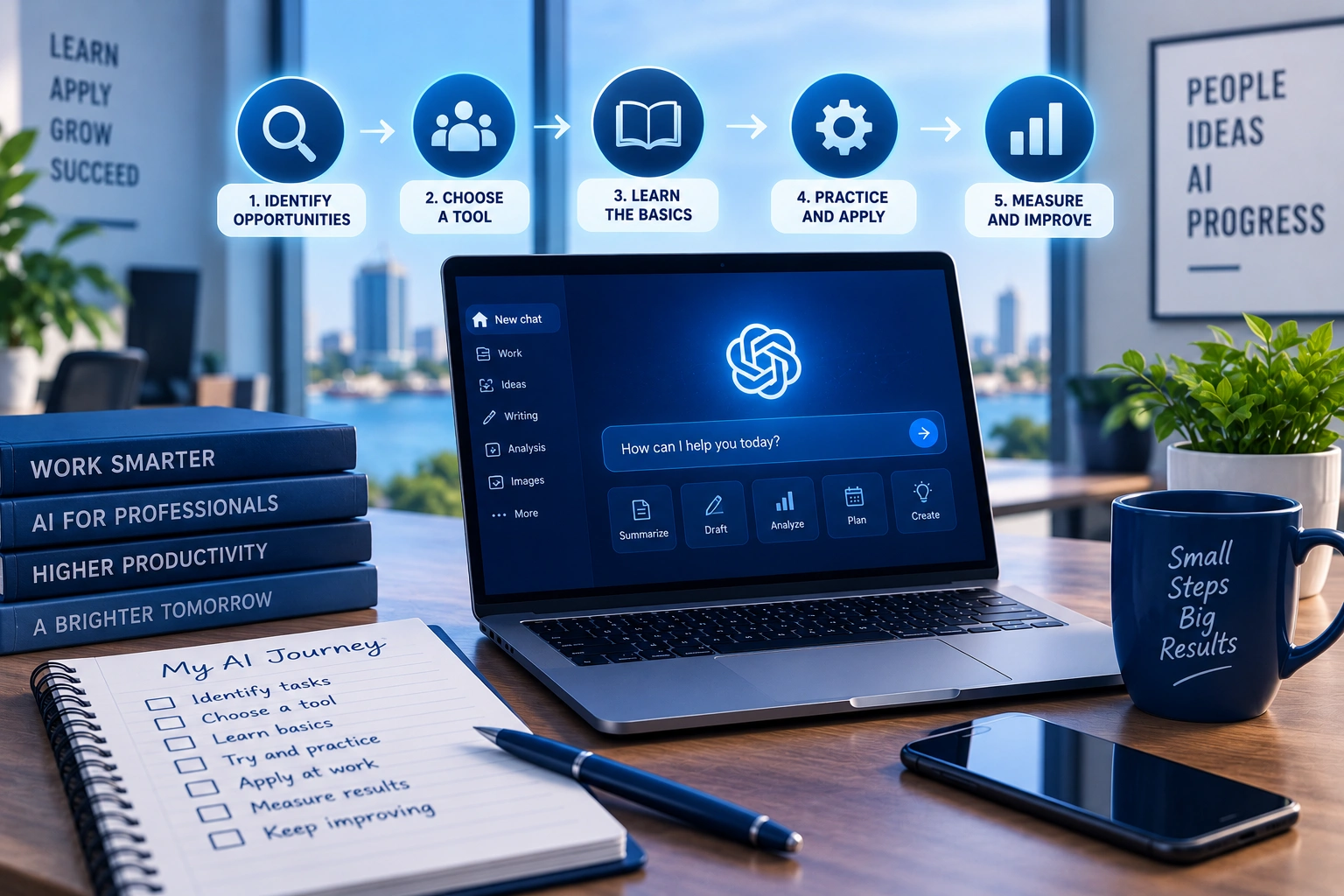
Once you can choose a use case well, the starting sequence itself is straightforward. Six steps take an organisation from intention to a proven first result.
Assess your readiness. Understand where your teams stand, which processes are candidates, and where the risks sit, before spending anything. This is the diagnosis that prevents wasted effort.
Choose one use case through the filter. Apply the four tests and commit to a single frequent, bounded, owned, and measurable task.
Set your data guardrails. Decide what data may and may not be used, and in which tools, before anyone starts. In a regulated environment this step is not optional.
Train the people who will run it. Give the owner and the team the practical skills to direct the AI, check its output, and integrate it into the work.
Measure the result. Compare against the baseline you set in step two, honestly, within a few weeks.
Expand deliberately. Use the evidence and the lessons from the first project to choose the second, and build from there.
The sequence is deliberately unglamorous, which is the point. It is the opposite of the large, visible launch that so often fails. The starting move, a readiness assessment, is also the cheapest and the most informative.
See how training fits into the whole journey
The complete guide covers what to learn, in what order, and how professionals and organisations each find their entry point.
Read the complete guide to AI training in TanzaniaYou keep AI safe by deciding what data it may touch before you begin, and by matching your deployment to your regulatory obligations. For banks, insurers, and government-linked organisations in Tanzania, this is not a secondary concern. Data sovereignty expectations and internal compliance policies, reinforced by Tanzania's national data protection and digital economy framework, often restrict where customer and financial information may be processed, which shapes how AI can be adopted.
Two practices matter from the first day. The first is preventing shadow AI, where staff paste confidential customer, financial, or personal data into public tools that are not approved for it. MIT's research found that unofficial personal AI use is widespread even where formal projects stall, which is a real data risk in any regulated organisation. The second is matching deployment to sensitivity. Where data cannot leave the organisation's controlled environment, on-premise deployment keeps AI capability inside the client's own infrastructure. This is exactly the environment iPF works in. iPF is ISO/IEC 27001:2022 certified, and the same team builds on-premise systems for regulated East African clients, which is the context iPF Academy teaches from.
Getting this right early is far cheaper than retrofitting it. A first project that respects data rules from the start can scale. One that ignores them has to be rebuilt or abandoned.
Assess your readiness before buying anything. A structured readiness assessment shows where your teams currently stand, which processes are the best candidates for AI, and where the risks are. Starting here prevents the most common and expensive mistake, which is purchasing a tool and rolling it out broadly before anyone knows where it will actually add value. The diagnosis costs little and shapes every decision that follows.
The evidence points to how projects are chosen and run rather than the technology itself. MIT's 2025 study of enterprise AI found that around 95 percent of pilots delivered no measurable business impact, mainly because tools were not integrated into real workflows and projects lacked clear ownership and measurement. Organisations that succeed start small, in a low-risk area, with a trained owner and a defined measure of success. Starting big and visible is the pattern that most often fails.
Most should start by applying existing tools to a well-chosen task, not by building custom systems. Building in-house is expensive in time, talent, and money, and it is rarely the right first step. The higher-value early work is integrating available AI into a frequent, bounded process and training the team to use it well. Custom development becomes worth considering later, once an organisation understands its own needs from real experience rather than assumption.
The starting cost is lower than most leaders expect, because a sensible first project uses existing tools on a single process rather than a large system build. The main investment is training the team and the time to run and measure the first use case. Because the right approach is scoped to one task, the cost is contained and the return is measurable, which is a stronger basis for further investment than an open-ended budget for a broad rollout.
Yes, when it is approached in the right order. The IMF notes that the region faces real constraints in skills and infrastructure, but these affect large, complex deployments far more than a focused first project on an internal process. A Tanzanian organisation can run a frequent, bounded, measurable AI use case today using tools that are already available. Starting small is not a compromise here. It is the correct strategy given the operating environment.
Decide what data may be used, and in which tools, before anyone starts, and match your deployment to your regulatory obligations. Prohibit staff from entering confidential customer, financial, or personal information into public tools that are not approved for it. For data that cannot leave your controlled environment, on-premise deployment keeps AI processing inside your own infrastructure. Setting these rules from the first project is far easier than correcting a breach or rebuilding a non-compliant system later.
A named owner who cares about the outcome and has authority over how the work is done, supported by leadership. This person does not need to be technical, but they do need to be accountable for the result and able to change the process. Successful first projects almost always have one clear owner, while stalled ones tend to be shared across a committee with no single point of responsibility. Pair that owner with a team that has been trained in the practical skills.
A well-chosen first use case should show measurable results within weeks, not months, which is one reason to select a task you can measure quickly. This is deliberate. A fast, provable first result builds the internal confidence and the evidence needed to justify the next step. Large, ambiguous projects that promise transformation in a year are exactly the ones that tend to stall, so the goal at the start is a small, clear win rather than a grand outcome.
An organisation in Tanzania can start using AI successfully, and doing so has far more to do with discipline than with spend. The organisations that join the small group getting real value are not the ones with the biggest budgets. They are the ones that start in the right place, with the right owner, and a way to prove the result.
Hold on to three ideas. Start with a diagnosis, not a purchase, because access to a tool is not capability with it. Choose a first use case that is frequent, bounded, owned, and measurable. And set your data rules from the first day, especially in a regulated sector. Do those three things and you sidestep the reasons most first projects fail.
iPF Academy exists to make this practical, taught by a team that builds AI systems for regulated East African organisations. The clearest first move is to find out exactly where your organisation stands today.
Find out where your organisation stands before you start
The assessment is free, takes only a short time, and gives you a clear readiness score and a direction for your first AI project.
Take the free AI Readiness Assessment